
Through the past 18-month period, peace has prevailed in the disputed border regions, which was immensely helpful in the difficult situation that the country was passing through, observes Ambassador M K Bhadrakumar.

Shortly after Pakistan Prime Minister Nawaz Sharif raked up Kashmir issue once again in his address at the UN General Assembly and termed his country as a victim of terrorism, India, in perhaps its harshest ever response, said de-militarising Kashmir was not the answer for achieving peace but "de-terrorising" Pakistan is.
Majority of the 15 members said there should not be any statement or outcome issued after the consultations and their will prevailed, leaving China to come out and make a statement in its national capacity followed by Pakistan.
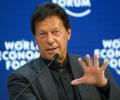
Khan also said Pakistan has decided to partner any other country only for peace and named the partnership with the US as the one.

'The Indian Army can easily initiate retaliation.' 'But escalation would be both inevitable and unpredictable.'
"The world's eye is on Kashmir and on Pakistan...I will be the ambassador who raises Kashmir's voice at every international forum," he said.
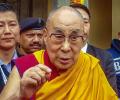
'The logical step is to challenge the very legitimacy of the Chinese claim over Tibet,' recommends Inspector General Gurdip Singh Uban (retd).
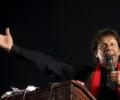
'I like him as a person, and as a politician.'

'How can Kashmir be demilitarised if the terrorist threat remains and Pakistan continues to incite elements in Kashmir to keep the internal situation unstable?' asks former foreign secretary Kanwal Sibal.
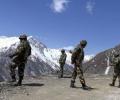
...with extravagant claims in both the eastern and western sectors, observes Ambassador Talmiz Ahmad, as India is fixated on asserting its border claims based on the McMahon Line.
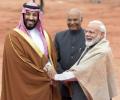
'No matter what Modi may boast about 'new India', the geopolitical reality is that India's stature diminishes when it needs a small country like Saudi Arabia under an autocratic ruler to help out with what is arguably one of the most critical templates of its diplomacy,' says Ambassador M K Bhadrakumar.
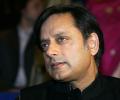
Union Minister Shashi Tharoor's video address to an Indo-Pakistan entrepreneurs' event in Islamabad was abruptly cut off after he lambasted the Pakistani government for ceasefire violations on the Line of Control and suggested the civilian administration did not control the military.

'General Sam Manekshaw looked from left to right and said, "Gentlemen, I have come to have a look at you. I am taking a good look at your faces. When I come back after the war is over, some faces may not be here".'

'This was the worst phase yet in the state's human rights history.' 'Notorious interrogation centres were set up, large numbers died in firing on civilian mobs.' 'This is what today's generations might identify better as the Haider phase in Kashmir's history,' says Shekhar Gupta.
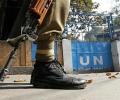
The recent decision of the Union government asking United Nations Military Observer Group on Kashmir to vacate a government-provided bungalow in New Delhi, is garnering mixed reactions in Kashmir. While many feel there would be no real impact if the UNMOGIP was to close its main offices in Srinagar, there are others who believe that the UN would continue to have a critical role till the Kashmir issue is resolved.

Any settlement with Pakistan won't last unless it comes with big power guarantees, says Shekhar Gupta.

Raising the issue of cross border terrorism during his first visit to Turkey, a traditional ally of Pakistan, President Pranab Mukherjee on Tuesday said the menace must be dealt both "individually and collectively" as it was a threat to global peace.
'No country can ever be free to make its choices and remain independent if it continues to wear borrowed plumes,' warn Lieutenant General Ashok Joshi (retd) and Colonel Anil A Athale (retd).

'It will be foolhardy to overlook that this stunning shift in China's stance comes as the culmination of the severely damaged India-China relationship under the present government,' says Ambassador M K Bhadrakumar.
'China is likely to help Pakistan in keeping the fire burning in J&K to bleed India for its own interests.' A fascinating excerpt from Lieutenant General K Himalay Singh's Making of a General: A Himalayan Echo.
'Secretiveness and the element of surprise in announcing decisions marks the Modi style of diplomacy. From being a voluble politician, he became a reticent statesman... But the diplomatic dance is performed on thin ice and his adroitness is still to be proved,' says Ambassador T P Sreenivasan.

Major General Sujan Singh Uban, a legendary veteran of the Second World War, was a natural choice to raise, train and command the Special Frontier Force and mould them into a well oiled fighting machine, recalls his son Inspector General Gurdip Singh Uban (retd), who led SFF troops during the Kargil War.

United Nations chief Ban Ki-moon has expressed readiness to engage with India and Pakistan in resolving the Kashmir issue if requested by both and asked them to resume talks to reach an agreement that would serve their security interests as well as that of the region.
'Modi's brilliance seems to be in combining Indira Gandhi's 'feel' for the Indian pulse and Narasimha Rao's cynicism.' 'By the time the Opposition leaders caught up with Modi over the 'surgical strikes', he had already moved on,' says M K Bhadrakumar.
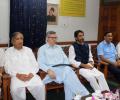
All opposition parties from J&K to apprise President of Kashmir situation.
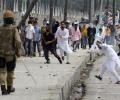
'There is a problem with the rise of a popular view that sees Kashmir through the prism of the larger, chronic Hindu-Muslim tensions.' 'By redefining the Kashmir problem simplistically in Hindu-Muslim terms could end up keeping Kashmir but losing most Kashmiris,' says Shekhar Gupta.

'Our policy seems to be to give away part of J&K, even though we are entitled to the entire state.' 'The Congress has done so, and the BJP is following the same policy.' 'No one is applying their mind to the legal position.' 'Kashmir is not a part of Pakistan under its own constitution.'

China has chosen to keep New Delhi guessing, while retaining for itself the option of constantly changing facts on the ground and shifting the LAC westwards -- the strategy called 'salami slicing', notes Ajai Shukla.

It would be realistic to see India's position on the DGMOs joint statement more as 'engagement, different from dialogue', where our subsequent options could be decided depending on the realities of the situation on the ground, notes Rana Banerji, who headed the Pakistan desk at the Research and Analysis Wing, India's external intelligence agency.
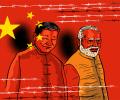
The reasons for China's negative response are located in its territorial dispute with India but also to its grand designs of dominating the region from its previous position of being merely a "balancer" between India and Pakistan, points out Srikanth Kondapalli, Professor in Chinese Studies at JNU.
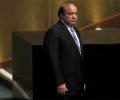
'Indian diplomacy is once again being saddled with the heavy burden of a Pakistan-centric foreign policy. It is something grossly unfair at a crucial juncture in India's trajectory as an emerging power on the global stage,' argues Ambassador M K Bhadrakumar.

Arpi deserves to be complimented for the commitment and hard work that have gone into this production. The frustrations of seeking reliable documentation from the catacombs of the Indian bureaucracy did not deter him from going after the best information available, and the result is one that he can take much satisfaction in. Ambassador Prabhat P Shukla, Member Advisory Council, Vivekananda International Foundation, reviews Claude Arpi's The End of an Era: India Exits Tibet.
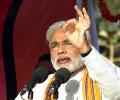
'Both reflect prejudice and short-sightedness peculiar to Mr Modi's way of thinking.'
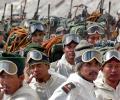
'India should stop claiming that a united Pakistan is in India's interests.' 'Pakistan's break-up is a necessity for peace and progress in the region,' says Major General Mrinal Suman (retd).

'Does the Indian army's new assertiveness risk a clash escalating into shooting and possibly skirmishes?' asks Ajai Shukla.

'Much can be done by India under the provisions of the treaty to make full use of its rights it has.' 'The impact of that will be felt downstream.'

'Chinese troops are not geared to fight Indian troops who are battle hardened and acclimatised and are far more hardy.'

During a war, there are just four possibilities a soldier faces. One: Victorious and safe. Two: Wounded. Three: Killed in action. Four: Prisoner of War. It was my fate to face the fourth, says Colonel Anil A Athale (retd) on the year spent as a prisoner of war in Pakistan during the 1971 War.

'It is a pattern of behaviour of the Chinese that whenever a Chinese leader visits India or an Indian leader visits China, some incidents take place.' 'When Modi visits China, we should look out for some similar demonstration by the Chinese.'

'Indira Gandhi proved herself a great war leader, but failed as a statesman,' says Colonel Anil A Athale (retd).
